Each year, companies across the personal care and detergency industries lose thousands of euros on something they don’t even realize: transporting water.
Let’s look at one of the most common culprits — Sodium Lauryl Ether Sulfate (SLES). If your plant uses a pre-diluted version (typically 27%), you’re paying to transport more w-a-t-e-r.
And what’s worse? You’re also absorbing the 𝗲𝗻𝘃𝗶𝗿𝗼𝗻𝗺𝗲𝗻𝘁𝗮𝗹 𝗰𝗼𝘀𝘁 of that choice.
The hidden cost of pre-diluted SLES
SLES is a fundamental ingredient for many formulations. But the truth is that the way it’s handled logistically hasn’t evolved for decades.
The problem?
- You’re tied to large-volume storage of diluted products.
- You depend on logistics that are increasingly costly and less flexible.
- You’re increasing your carbon footprint for something that brings no added value.
All of this leads to higher costs, less flexibility, and unnecessary emissions.
A smarter way: in-house dilution with Laurilvak®
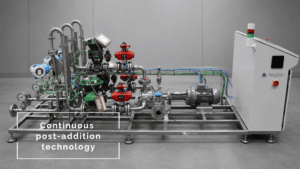
Imagine receiving concentrated SLES (70%) and diluting it in-house, safely, efficiently, and with full control. That’s what the Laurilvak® system allows you to do.
We designed Laurilvak® with one goal: to help manufacturers save — without compromising on product quality or operational safety. Whether you store concentrated SLES or unload it directly from the truck, the Laurilvak® system adapts to your setup.By switching to Laurilvak®, companies benefit from:
- Direct savings on purchase of raw material and transport costs
- Reduced CO₂ emissions linked to transportation
- Full control of dilution at the plant
- Improved operational efficiency and space optimization
- Same quality as pre-diluted SLES, backed by technical validation
Want to see how it works?
Watch this short video about Laurilvak.
Just a few seconds to show you how 𝗟𝗮𝘂𝗿𝗶𝗹𝘃𝗮𝗸® integrates into your production process — no complexity, no disruption.Reproducir
Trusted by Industry Leaders
We have installed over 100 𝗟𝗮𝘂𝗿𝗶𝗹𝘃𝗮𝗸®. Our system is trusted by major manufacturers, companies that have streamlined their logistics, improved sustainability, and reduced costs — all with a single, adaptable system.
Ready to stop paying to transport water? Let’s talk!