From powder to homogeneous product: solving solid-liquid mixing challenges in the food industry
When a fertiliser does not dissolve: understanding the process before choosing the mixing Technology
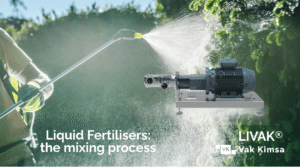
In the manufacture of liquid fertilisers, not everything added to a tank needs to dissolve completely.
Depending on the formulation, we may find salts that need to be dissolved, mineral particles that need to be dispersed, or solids that must remain in suspension throughout the process.
And this difference is fundamental.
Because if the goal of the process changes, the mixing technology you need can change completely too.
The first question is not which agitator we need
The question is: What needs to happen to the product during the process?
These are three different objectives:
- Dissolving a salt.
- Dispersing an insoluble solid.
- Keeping particles in suspension during storage.
In the first case, we want to promote contact between the liquid and the solid until dissolution is achieved.
In the second, the solid will not disappear into the liquid: the aim is to achieve proper dispersion and the highest possible degree of uniformity.
In the third case, the challenge goes even further: we need to prevent the particles from settling at the bottom of the tank.
This is where it makes sense to decide whether the process requires an agitator, an in-line mixer or a combination of both technologies.
When tank agitation is the right solution
A tank agitator can be particularly suitable when we need to:
- Keep solids in suspension.
- Prevent sedimentation.
- Generate circulation throughout the entire tank volume.
- Maintain product homogeneity during processing or storage periods.
- Compensate for density differences between the different phases.
The flow pattern generated by the impeller must reach the areas where sedimentation may occur and keep the particles moving.
This makes parameters such as particle density, solids content, viscosity, particle size, tank geometry and impeller type essential considerations.
What if the challenge cannot be solved inside the tank alone?
This is where another option comes into play: in-line mixing.
An in-line mixer acts on the product as it flows through the pipework, concentrating the mixing action at a specific point in the process.
This configuration can be particularly useful when we want to:
- Promote rapid dissolution.
- Disperse components as they are incorporated.
- Homogenise the product during recirculation.
- Reduce the time required to achieve uniformity.
- Combine different product streams in a controlled manner.
And it does not necessarily replace the agitator.
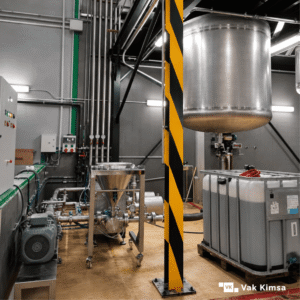
In certain processes, tank agitation and in-line mixing can work together.
The agitator maintains the appropriate conditions inside the tank, while the in-line mixer provides a more intensive mixing action within the recirculation circuit.
A real application: two processes, two different requirements
In a real application delivered by VAK KIMSA, we encountered two different situations.
The composition changed, and so did the challenge:
- Dissolution – Calcium nitrate + water
In this case, the main objective was to promote the dissolution of the components.
Calcium nitrate has high solubility in water, so the challenge is to achieve efficient incorporation and dissolution within the process.
Tank agitation may be the right solution, provided that the batch volume is not so large that the process could be carried out more efficiently using an in-line mixer.
- Dissolution, dispersion and suspension – Lignosulfonate + magnesium carbonate + water
Here, the behaviour changes.
Magnesium carbonate is practically insoluble in water, so the objective is not simply to make it «disappear» into the liquid. The challenge is to achieve proper dispersion and keep the particles in suspension.
Lignosulfonate is soluble in water, but it accounts for a very high proportion of the formulation. The challenge is therefore to incorporate such a large quantity of solid while also achieving efficient dissolution in water.
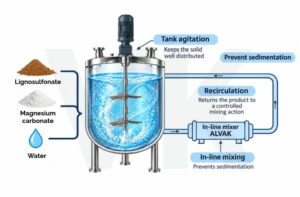
In this case, combining the following technologies makes perfect sense: Tank agitation + recirculation + in-line mixing.
In-line mixing, in this configuration, concentrates the mixing action at the point where the product circulates, and provides the most effective solution. It works alongside tank agitation, which generates a sufficient flow pattern to keep the solids distributed throughout the entire tank volume.
When solids concentration changes the rules
In these applications, process conditions can become particularly demanding:
- Product density: approximately 1,500–2,000 kg/m³.
- Solids content: approximately 45–60%.
At these concentrations, we are no longer dealing with a simple liquid containing a small amount of solid material.
The amount of solid phase, density differences and product behaviour can completely change the way the product circulates inside the tank.
And this is where one of the main risks arises: the product may appear homogeneous at the surface without actually being homogeneous throughout the entire volume.
- A poorly circulated bottom zone can promote solids accumulation.
- An undersized impeller may not generate sufficient pumping capacity.
- Excessive speed, on the other hand, may introduce more energy than the process actually requires.
This is why more power does not necessarily mean better mixing.
Dissolution, dispersion or suspension: three different challenges
We can summarise the differences as follows:
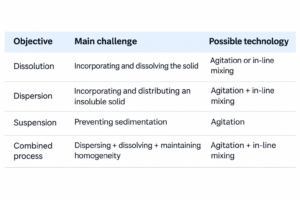
This is not a universal rule.
Each formulation needs to be assessed individually, especially when solids concentration, product density or density differences between phases increase.
The right technology is the one that addresses the phenomenon we need to control
There is no universal agitator for liquid fertilisers.
The solution may involve a high-pumping-capacity impeller, a specific configuration for keeping solids in suspension, an in-line mixer or a combination of different technologies.
The key is to start with the process and understand it:
- What do we need to dissolve?
- What do we need to disperse?
- What must remain in suspension?
- For how long?
- What is the batch volume?
Only once these questions have been answered can the right equipment be selected.
Because in industrial mixing, the goal is not to move the product more. It is to move it in the right way.
Let us help you find the right solution for your process: Get in touch!