

When working with fluids of varying viscosities, pastes or suspensions -as is common in the food, chemical or water treatment industries- any anomaly in the system can lead to serious consequences.
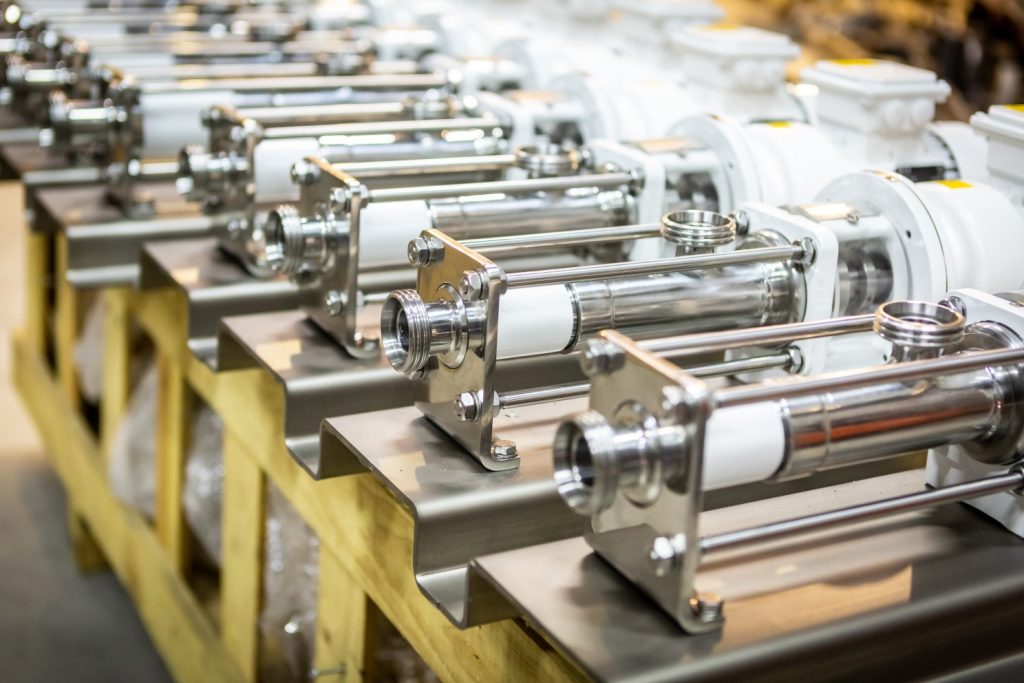
𝗛𝗲𝗹𝗶𝗰𝗮𝗹 𝗽𝘂𝗺𝗽𝘀 are essential equipment in the various manufacturing processes of many different sectors. They are positive displacement rotary pumps operating by means of a rotor turning inside a stator, moving a constant volume of fluid per revolution, smoothly and without pulsation.
This type of pump is particularly useful for viscous fluids, fluids containing particulates or sensitive to shear. Their flow is reversible and they maintain a nearly constant flow -even under variations in pressure or viscosity. Our pumps can reach high pressures (up to 24 bar) and manage flow rates from 500 to 100,000 L/h depending on the model, and allow passage of soft solids up to 80 mm or hard solids up to 20 mm, depending on the configuration.
At Vak Kimsa we manufacture pumps in two main series –industrial and sanitary– which are in high demand within these sectors.
What can happen when they are not properly selected or operated?
The correct selection of a pump, based on a precise definition of the process and on Vak Kimsa’s technical experience in designing pumping solutions, is critical to guarantee the efficiency and durability of the system.
However, the lack of information or knowledge about operating criteria can generate recurring incidents and operational problems.
We have selected the five most common symptoms when something is going wrong with your pump:
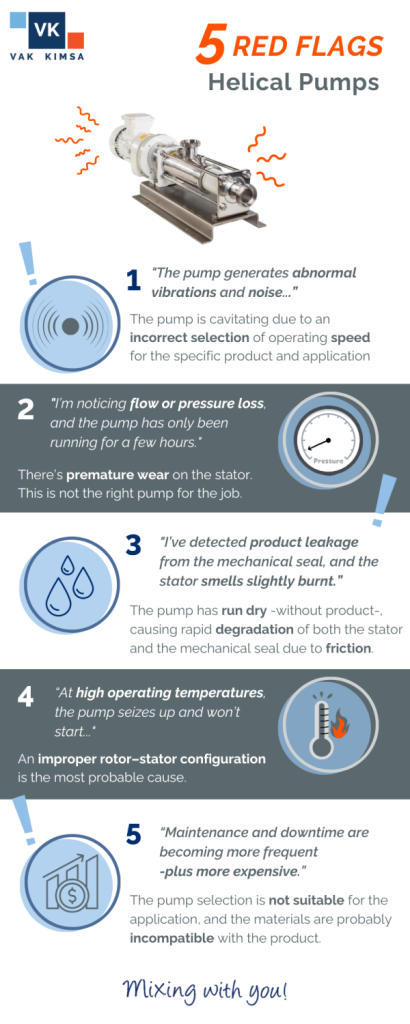
1. Abnormal vibrations and noise
“The pump produces strange vibrations and noises…”
This symptom commonly indicates cavitation, typically caused by an incorrect selection of operating speed in relation to the product and application. If not corrected in time, it can cause internal damage and unexpected downtime.
2. Loss of Flow or Pressure
“I’ve noticed a loss of flow or pressure and the pump has barely been running.”
This scenario often points to premature wear of the stator, which usually arises when the pump is not well suited to the product or the operating conditions.
3. Leaks and a Burnt Smell
“There is product leakage through the mechanical seal and the stator smells burnt.”
This issue suggests the pump has run dry—that is, without fluid—which generates friction and rapid degradation of both the stator and the mechanical seal.
4. Problems at High Temperatures
“When operating at high temperatures, the pump seizes and won’t start…”
This behaviour is often the result of inadequate rotor–stator geometry design, one that cannot tolerate demanding thermal conditions. Poor design can seriously compromise process continuity.
5. High Maintenance Costs and Frequent Downtime
“The costs of maintenance and downtime are becoming increasingly frequent (and expensive).”
When this happens, it is usually because the pump was not properly selected for the application or because the materials are incompatible with the fluid being pumped.
Solutions
At Vak Kimsa we have extensive experience in identifying and preventing these process incidents. Through precise technical selection adapted to each application, we ensure:
- Reliability and operational continuity of the system
- Optimization of operating and maintenance costs
- Specific adequacy to the product, working regime and service conditions
Our Helical Pumps are designed to minimize operational risks, avoid these critical points (red flags) and guarantee stable, efficient and long-lasting operations.
Reliability, efficiency and confidence with every pump.
Need expert advice? If you doubt about whether your pump is the right one for your product or for your service conditions, don’t hesitate and contact us! Our Helical Pump Process Engineering team will be happy to help.
𝗔𝘁 𝗩𝗮𝗸 𝗞𝗶𝗺𝘀𝗮 𝘄𝗲 𝗵𝗲𝗹𝗽 𝘆𝗼𝘂 𝘁𝗿𝗮𝗻𝘀𝗳𝗼𝗿𝗺 𝗽𝗿𝗼𝗯𝗹𝗲𝗺𝘀 𝗶𝗻𝘁𝗼 𝘀𝗼𝗹𝘂𝘁𝗶𝗼𝗻𝘀.