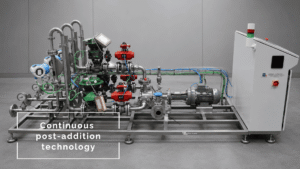

As a producer in the chemical or food industry, at some point you’ll want to have validated a new mixing process. If lab results aren’t conclusive enough -and if, without being able to test the process under real conditions, critical deviations may arise in dosing time, product stability, or line efficiency -one viable solution is the temporary rental of an in-line mixing unit.
Have you ever considered it?
In one of our customers’ cases, it enabled them to simulate continuous, full-scale production of plant-based milks directly at their facility. The outcome was rapid validation, precise adjustments, and a safe start-up of the new product.
Best of all: the savings. In every sense.
Testing in real conditions: the key to reducing uncertainty
When a company in the chemical or food sector works with complex formulations, process validation is critical. Lab and pilot-plant trials provide a baseline, but they often don’t capture all real production variables: piping, temperature, pressure, etc.
This company was exactly at that point: they had designed a new product and run preliminary tests, but they needed to confirm everything would work continuously with the real equipment, connections, and fluids in their production environment.
The main unknown was whether the mix would remain stable under the existing flow/pressure conditions—and whether dosing time could be adjusted without compromising quality.
A flexible, controlled solution: renting an in-line mixing unit
To meet this need, they chose to rent an in-line mixing unit adapted to their process. Designed for temporary installation in existing lines, the system allowed them to:
- Integrate with the customer’s plant connections, ensuring compatibility and safety.
- Replicate the real workflow, including typical pressures and temperatures.
- Adjust parameters in real time to find optimal operating conditions.
Technical support during installation and testing ensured the customer got the most out of the equipment while reducing risk.
Results that deliver confidence and speed
In under a week of real-world trials, the company was able to:
- Validate the feasibility of the new process.
- Identify and correct minor dosing imbalances.
- Prepare their line for stable, safe production.
This approach saved them months of inefficient testing—or premature investment in permanent equipment.
In-line mixing
In-line mixers have many applications, both batch and continuous, for solid–liquid and liquid–liquid mixing.
The operating principle is based on generating controlled turbulence within the flow using mechanical elements such as high-speed rotors or specially designed static elements. This ensures homogeneous distribution of components in fractions of a second, maintaining final product consistency.
Advantages of an in-line mixing unit: uses and benefits
In-line mixing systems are widely used in the chemical, cosmetic, food, and pharmaceutical sectors to combine fluid ingredients continuously and efficiently, and to disperse and dissolve solids into liquids. Key advantages include:
- Continuous production: Process large volumes without interruptions, increasing throughput.
- Challenging dispersions: Lower power demand compared with Cowles agitators, improving energy efficiency.
- Repeatability and consistent quality: Every “drop” is treated the same way, ensuring uniformity.
- Better parameter control and traceability: In-line sensors enable real-time monitoring and immediate adjustment.
- Space optimization: Smaller footprint than traditional mixing tanks.
Specific applications in the chemical industry
In-line mixers are especially valuable in chemical processes requiring precision and speed:
- Liquid fertilizer production
- Polymer and resin manufacturing
- Detergent and cleaner manufacturing
For liquid fertilizers, in-line mixers offer additional advantages: the ability to handle concentrated solutions that may contain suspended particles, the option to add multiple components sequentially while maintaining stability, and flexibility to adapt formulations to seasonal needs or specific crops.
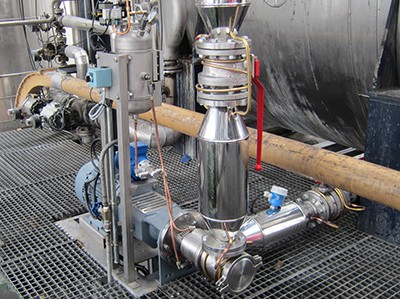
Prior validation: pilot-plant trials before rental
Before bringing a unit to the customer’s site, at Vak Kimsa we offer the option of preliminary testing at its advanced pilot plant. This facility supports scale-up at 15, 50 and 100 liters, enabling representative industrial conditions to be reproduced in a controlled setting.
Trials can be carried out at our site with the customer present, or via live streaming, making it easier for different departments to participate while avoiding travel costs.
This step significantly reduces the risk of on-site trials and speeds up final validation.
The rental service: flexibility without investment commitment
The rental service adds value: it allows in situ validation before a final investment, with the support of an expert team throughout. Rental units come fully equipped with an electrical control cabinet and are ready to connect and test immediately.
This model offers several strategic advantages:
- Minimal upfront investment: No need to commit capital before validation.
- Controlled-risk trials: Adjustments can be made without having purchased the final unit.
- Flexible timing: Rental aligns with the project timeline, from days to months.
- Technical support included: Installation, commissioning, and support during testing.
- Learning opportunity: Production teams can become familiar with the technology before purchase.
For companies developing new products or optimizing existing processes, this option removes barriers and accelerates decision-making.
Want to run plant trials with maximum assurance?
Let’s talk and find the most efficient option for your case—whether starting with pilot-plant trials or moving directly to equipment rental for in situ validation.