
In sectors such as detergency, cosmetics or food, it is common to see how a correct formulation stops behaving as expected when it goes into production
Xanthan gum is a key ingredient in many industrial processes: it provides 𝘃𝗶𝘀𝗰𝗼𝘀𝗶𝘁𝘆, stability and precise rheological control. But it also has a characteristic that is often overlooked: it is extremely sensitive to how it is mechanically handled.
In sectors such as detergency, cosmetics or food, it is common to see how a correct formulation stops behaving as expected when it goes into production: the product arrives with less body, the texture changes or becomes unstable.
The invisible point is usually the fluid handling —agitation and pumping— and whether the xanthan works as it should or becomes degraded before reaching the final process.
The key question: is it really a formulation problem… or a process problem?
In many cases, what is happening has nothing to do with the recipe.
Everything seems correct: the mix has been done well, the parameters are adequate and the laboratory results are consistent. But when the product is transferred between equipment, its structure begins to degrade.
Viscosity drops, texture changes and deviations appear that end up affecting the final quality of the detergent: inconsistencies in dosing, phase separation, changes in the appearance of the finished product.
The reason is frequently that the pumping system selected is not suitable for pseudoplastic fluids like xanthan..
Why xanthan is especially vulnerable to shear
Xanthan gum is a microbial-origin polymer with a double-helix molecular structure that gives it its unique rheological properties. This structure is precisely what makes it so valuable in formulation… and so fragile when subjected to inadequate pumping. Its viscosity decreases as shear rate increases.
This means that under aggressive pumping conditions, the fluid behaves deceptively —it flows well at that moment— but once it stops, the molecular structure no longer fully recovers. If a centrifugal pump is used with xanthan solutions, the fluid is subjected to high speed and a high level of shear.
If a centrifugal pump is used with xanthan solutions, the fluid is subjected to high velocity and a high level of shear. On some occasions, when not properly applied, it has been observed that this can have direct and measurable consequences:
• Degradation of the xanthan structure
• Irreversible loss of viscosity
• Changes in the rheological behaviour of the detergent
• Process instability and variability in the final product
Although it is difficult to break down the rheological properties of xanthan, it can sometimes happen. The result: the final product is no longer what was originally formulated. And this requires adjustments, corrections and, often, reprocessing.
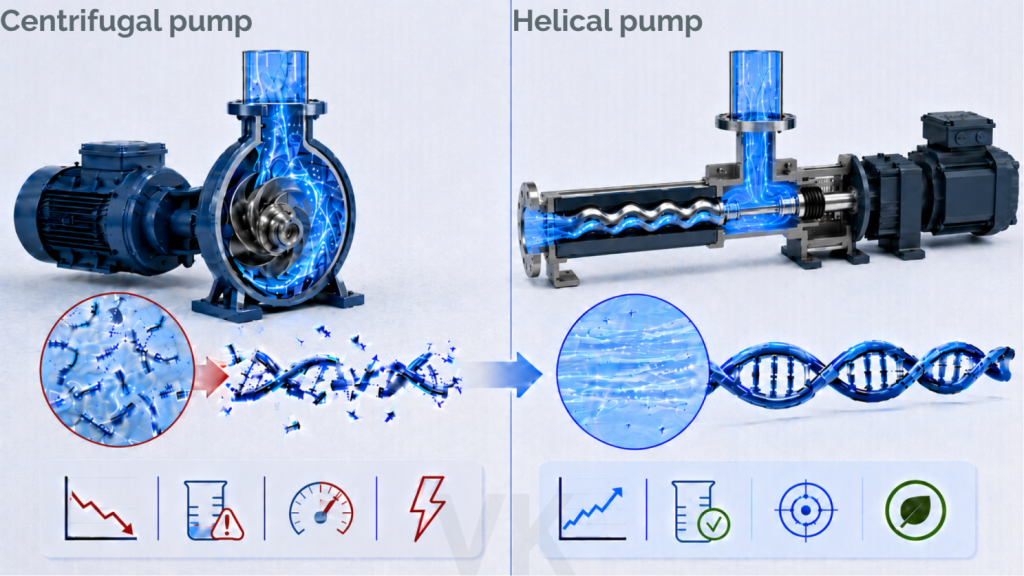
Progressive cavity pump makes the difference
The Piton® helical pump is designed to protect the product throughout its journey. Its operating principle is based on progressive, controlled displacement, without unnecessary mechanical stress.
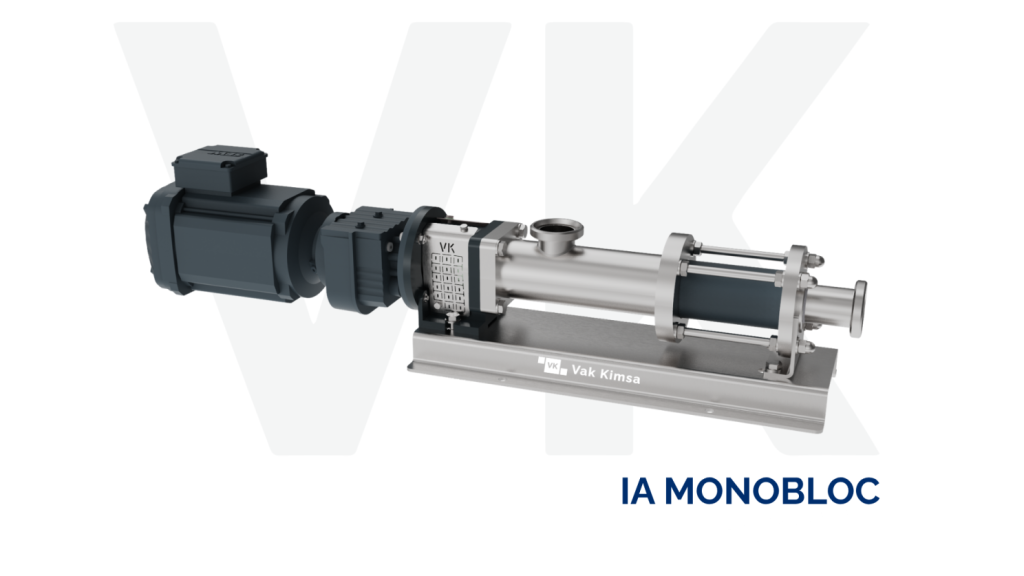
In applications such as detergency, where hygiene and production capacity are decisive, our 𝘀𝗮𝗻𝗶𝘁𝗮𝗿𝘆 range —with models such as our 𝗜𝗔 𝗠𝗼𝗻𝗼𝗯𝗹𝗼𝗰— offers a specific response to the demands of the sector:
• Flow rates of up to 100,000 L/H, adapted to high-volume lines
• Compact design that takes up less floor space, making integration into existing or new installations easier
What does this mean in practice?
✔Smooth, continuous fluid movement
✔ Low shear level, preserving the xanthan structure
✔ Conservation of the product’s rheological properties
✔ Stable flow rate, independent of viscosity
✔ Good suction, even with dense or loaded fluids
This keeps the product’s properties fully intact from formulation through to the final filling or dosing point.
Why choose a positive displacement pump for detergent formulation with xanthan?
In the detergency industry, xanthan is used as a thickening and stabilising agent in liquid detergents, fabric softeners, surface cleaners and gel cleaning products. In all these cases, rheological consistency is critical: the consumer expects a homogeneous product with the right viscosity and predictable dosing behaviour.
Where a helical pump is typically used in these processes:
• Transfer of hydrated xanthan solutions to mixing tanks
• Precise dosing of the thickening base in continuous production lines
• Recirculation of viscous blends with surfactants, colorants or fragrances
• Feeding filling lines where product consistency is critical
What it brings to the production process:
✔Preserves the xanthan structure and therefore the final viscosity of the detergent
✔Maintains a constant flow rate, even when the formulation changes from batch to batch
✔Enables precise and repeatable dosing
✔Better handles formulations loaded with particles or suspended solids
✔Reduces batch-to-batch variability and improves process traceability
Greater stability in detergent production: a progressive cavity pump eliminates xanthan degradation, reduces variability and optimises the process.
Optimisation is often found where least expected
When we talk about industrial optimisation, we often think of major formulation changes or new ingredients. But many times, the key lies in a much more discreet point: how the product moves within the plant.
A suitable pumping system can completely transform process behaviour:
• Reduces variability between production runs
• Avoids quality losses due to xanthan degradation
• Minimises reprocessing and out-of-spec batches
• Optimises energy consumption
• Improves overall process control and finished product consistency
In short, it turns a problem into an opportunity for continuous improvement.
Because in the world of formulation and process, what matters is not only how the product is formulated… 𝗯𝘂𝘁 𝗵𝗼𝘄 𝗶𝘁 𝗶𝘀 𝗵𝗮𝗻𝗱𝗹𝗲𝗱 𝗮𝘁 𝗲𝘃𝗲𝗿𝘆 𝘀𝘁𝗲𝗽 𝗼𝗳 𝘁𝗵𝗲 𝗽𝗿𝗼𝗰𝗲𝘀𝘀.
If you want to learn more about our Piton® Helical Pumps, please contact us!