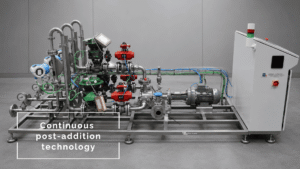

Creating 𝘀𝘁𝗮𝗯𝗹𝗲 𝗲𝗺𝘂𝗹𝘀𝗶𝗼𝗻𝘀 𝗮𝘁 𝗶𝗻𝗱𝘂𝘀𝘁𝗿𝗶𝗮𝗹 𝘀𝗰𝗮𝗹𝗲 remains one of the most challenging transitions in chemical manufacturing.
Why lab emulsions fail at scale
In the lab, creating a stable emulsion often feels deceptively easy. A beaker, a few hundred milliliters of liquid, a surfactant, and a handheld high-shear immersion blender, a rotor-stator probe, or even a small overhead stirrer—can deliver results that look perfect: smooth texture, fine droplet size, and quick «proof» that the formulation works.
Then comes the scale-up.
The root cause: mixing conditions that don’t translate The problem isn’t the formulation -it’s that lab-scale success often relies on mixing conditions that simply don’t exist in 500–5,000 liter production tanks. What works perfectly in a beaker can become inconsistent, unstable, or impossible to reproduce when volumes increase 100-fold or more.
The solution lies in engineering repeatability: replicating not the lab tool itself, but the mixing effect it delivers—specifically, the shear intensity, flow patterns, and processing time distribution that create stable emulsions. This requires purpose-built industrial equipment designed to ensure every liter of product experiences the same controlled mixing history.
This means transitioning from handheld immersion blenders or rotor-stator probes to industrial-grade solutions: in-line emulsifiers that control shear through recirculation loops, bottom-entry high-shear units that optimize flow from the tank base, and powder induction systems that eliminate the fish-eye agglomerates that plague scale-up.
The result: consistent droplet size, predictable viscosity, and batch-to-batch stability —eliminating the reformulation cycles, production delays, and quality issues that cost manufacturers time and money.
What happens when you scale up?
As soon as the same recipe moves from 1–5 liters to 500–5,000 liters, that «perfect lab emulsion» can turn into something very different: phase separation after a few hours, unexpected viscosity jumps, aeration, temperature rise, or inconsistent quality between batches. The product that behaved beautifully in a glass vessel may suddenly become difficult to reproduce in a real tank.
𝗪𝗵𝘆? Because in emulsification, what matters is not only what you mix, but how energy is delivered and distributed. In a small beaker, it’s easy to expose most of the volume to high shear quickly. In an industrial vessel, it’s easy for part of the tank to see strong shear while other zones remain under-processed. And emulsions are unforgiving: droplet size distribution, exposure time to shear, addition sequence, and temperature control can make or break stability.
The core problem is simple: lab tools create emulsions under conditions that do not automatically exist at industrial scale.
Let’s amplify what usually goes wrong
Because these issues are common, costly, and sometimes misunderstood.
1) «Same RPM» doesn’t mean «same mixing»
In the lab, you might run a handheld rotor-stator at a given speed and get a stable emulsion in minutes. At industrial scale, the same «speed» concept doesn’t translate. The fluid dynamics, circulation patterns, and shear exposure are completely different. The result is often uneven droplet size: some zones over-sheared, others under-sheared.
2) Time-to-homogeneity becomes the hidden enemy
In a beaker, the whole volume quickly passes through the high-shear zone. In a tank, without the right configuration, a portion of the batch may circulate slowly, meaning your emulsion gets partial processing. That can create weak points: instability, creaming, sedimentation (if solids are present), or drifting viscosity during storage.
3) Heat and aeration appear «out of nowhere»
Lab emulsification can generate heat, but volumes are small and heat dissipates easily. Industrial high-shear processes can build heat fast, impacting viscosity, surfactant performance, or even causing volatile losses. At the same time, vortexing or poor addition methods can trap air, leading to foam, oxidation risks, and density variability.
4) Powder incorporation becomes a scale-up trap
Many emulsions aren’t just oil + water: they include stabilizers, thickeners, proteins, gums, pigments, or functional powders. In the lab, you sprinkle powders slowly and fix lumps with the blender. In industry, powders can form stubborn fish-eyes (dry cores protected by a gel layer), creating long mixing times and inconsistent results.
5) The lab setup often «cheats» with proximity
A handheld tool operates very close to the whole product. In a 2,000-liter tank, you need engineered flow paths: controlled circulation, defined shear zones, and repeatability. Without that, quality depends too much on operator technique, timing, and luck.
All of this leads to the same painful moment: the formula is right, but the process isn’t scalable.
The good news: scale-up becomes predictable
When you stop trying to replicate the tool and start replicating the mixing effect—especially shear level, flow pattern, and processing time distribution.
1) Understand what lab tools are really doing
An immersion blender or lab rotor-stator typically delivers:
- High localized shear (droplet break-up happens here)
- Short recirculation paths (most product quickly returns to the shear zone)
- Fast batch turnover (a large fraction of the volume is processed repeatedly)
When moving to industry, you need equipment that recreates those effects in a controlled and scalable way.
2) Match the industrial emulsification architecture to the product
In industry, emulsification is commonly achieved with:
A) In-line emulsifiers (rotor-stator in a recirculation loop)
This is often the most direct «scale-up cousin» of a lab high-shear tool.
- The product is pumped through a defined shear zone
- You can control flow rate, number of passes, and residence time
- Excellent for repeatability and for retrofitting existing tanks
Best when you want: Consistent droplet size, Strong control over process variables, Flexibility across multiple recipes.
– Read more about our LIVAK solutions.
B) Bottom-entry tank emulsifiers (high-shear unit at the tank bottom)
This approach puts the shear where it matters and improves drawdown.
- Great for pulling phases into the shear zone
- Minimizes surface vortexing (often helps reduce aeration)
- Can be very efficient for batch emulsification
Best when: You want compact integration (no external loop), you need strong draw at the bottom for good turnover, space or piping complexity should be minimized.
In many real plants, results improve dramatically when the emulsification device is paired with a main agitator designed for bulk circulation
This happens because emulsification needs both:
- Macro-mixing (move all product through the tank)
- Micro-mixing (apply shear to break droplets)
– Discover our MULFOLIVAK and MULFO LK impellers
3) Don’t forget the powder dispersion step
If your emulsion includes powders (thickeners, stabilizers, pigments, proteins), you’ll often need a dedicated approach to powder incorporation.
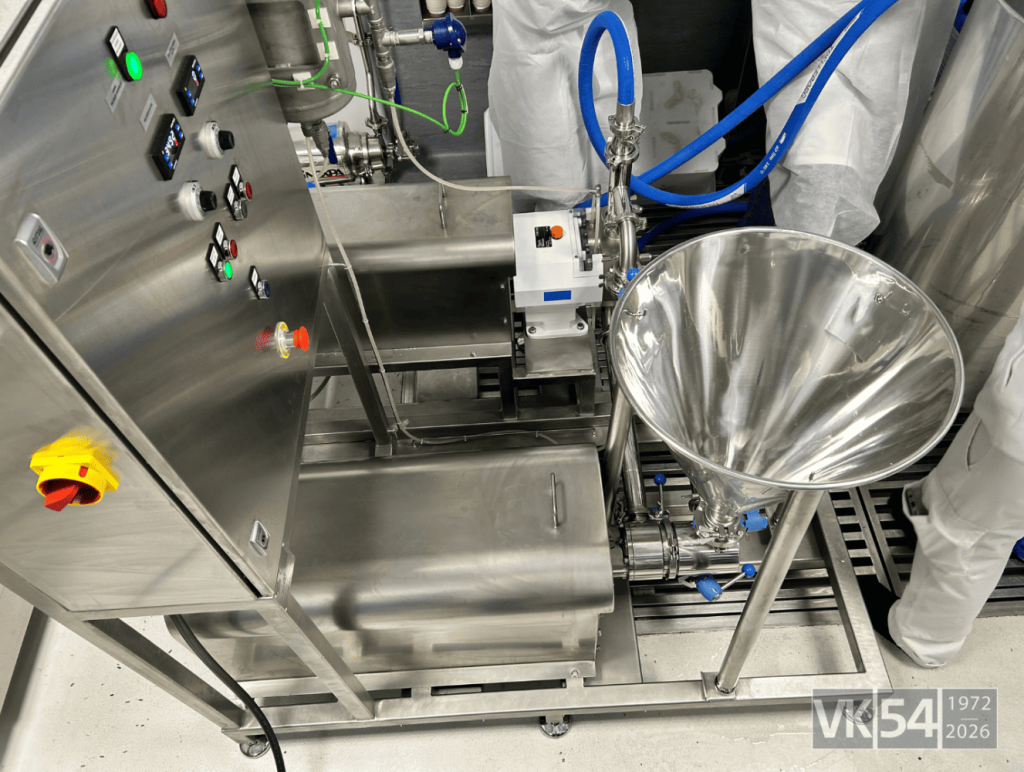
A proven industrial solution is a powder induction and dispersion system—conceptually similar to an in-line emulsifier, but with a hopper and controlled suction:
- Liquids circulate through the in-line high-shear head
- Powders are inducted under vacuum/suction into the rotor-stator zone
- Agglomerates are broken immediately, reducing fish-eyes and lumps
- Wetting and dispersion become faster and more repeatable
This typically delivers:
- Shorter batch times
- Less operator dependency
- Cleaner powder handling (less dust)
- More consistent viscosity development
– Read more about our ALVAK and VISCOVAK solutions.
4) Build a scale-up roadmap (practical and realistic)
A solid scale-up plan usually includes:
- Define the target quality markers: droplet size range, viscosity curve, stability time, appearance
- Replicate the process sequence: phase addition order, temperature profile, shear exposure time
- Choose the right industrial configuration: in-line loop, bottom-entry, or hybrid
- Test with a pilot approach that mimics industrial flow paths (not just a bigger beaker)
- Lock parameters that matter most: flow rate, passes, shear intensity, temperature, and powder addition method

Closing thought
Scale-up in emulsification is not about «going bigger.» It’s about engineering repeatability: ensuring every liter of product experiences the right mixing history.
When you bridge the lab tool’s high-shear effect with industrial solutions like in-line emulsifiers, bottom-entry high-shear units, and powder induction dispersers, you turn scale-up from a risky leap into a controlled transition—saving time, avoiding reformulation panic, and delivering consistent quality from the first industrial batch.
Get in touch with our team when scaling-up from lab to plant. We are happy to help!