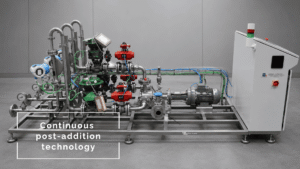
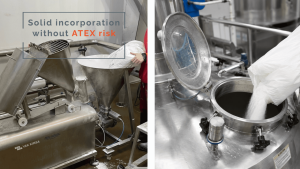
Micrometric control in critical processes
𝘈𝘣𝘴𝘵𝘳𝘢𝘤𝘵
Batch-to-batch variability in emulsification and dispersion processes is caused by a lack of micrometric control, which can directly impact the final product quality and competitiveness. This inconsistency can have a significant impact on the process, leading to wasted time, resources, and, most importantly, eroding customer trust.
Can we really quantify the cost of this variability?
Let’s explore how multi-stage technology can work in these processes and what aspects it can control or improve. Not all shear processes are the same. Multi-stage mixing technology provides much more precise control, improving batch consistency, reducing the need for rework, and increasing operational efficiency. Controlling key parameters such as droplet size and particle distribution is crucial for achieving high-quality emulsions and dispersions, avoiding common issues like phase separation or instability.
By using appropriate shear processes, more repeatable and efficient results are achieved, which not only improves quality but also reduces operational costs.
How many times have you looked at two “identical” batches and seen different results?
Same formula. Same parameters. Same equipment. Yet one batch has the silky texture you’re after, whilst the other presents lumps, phase separation or a particle‑size distribution that fails to meet specification. And the most frustrating part: you don’t really know why.
In processes where shear and mixing are critical — emulsions in food, dispersions in cosmetics, suspensions in pharma — the difference between an excellent product and a batch needing rework is measured in micrometres. And when your conventional equipment doesn’t deliver the control required, variability becomes your worst enemy.
The costly inconsistency
Can we really quantify what this inconsistency is costing us?
The lack of micrometric control in emulsification and dispersion processes isn’t just a technical inconvenience; it directly impacts your results:
- Wasted time & resources in re‑processing Every batch that fails specification means lost production hours, a halted line, equipment dedicated to resolving the issue and compromised raw materials. In a plant under tight deadlines and margins, rework is not an option: it’s a drain.
- Lot‑to‑lot inconsistency that damages your reputation Clients -whether end consumers or formulation customers- expect consistent quality. A cream that’s silky one month and grainy the next. A mayonnaise that shines sometimes and separates at other times. A pharmaceutical suspension showing visible lumps. Every deviation erodes trust and competitive advantage.
- Hidden costs in over‑engineered equipment Many processes try to compensate for lack of control with more passes, longer times, higher energy. They deploy expensive colloid mills, high‑pressure homogenisers or multiple recirculations, boosting energy consumption, heating the product (which degrades sensitive ingredients) and complicating formulation.
- Innovation and scale‑up limitations When you can’t master the process at the micrometric scale, each new development is a guess. What works in R&D doesn’t replicate in production, scale‑up becomes a trial‑and‑error process, and product launches to market are delayed by months.
The key question is: can we afford to keep operating with this level of variability, or do we need a solution that delivers actual control, demonstrable repeatability and operational efficiency?
The answer lies in understanding that not all shear processes are equal. And to achieve high‑quality emulsions and dispersions consistently, you need a technology specifically designed to multiply break‑up opportunities, control particle/drop‑size distribution and do so with operational and economic efficiency.
Multi‑stage rotor–stator architecture
Multi‑tooth mixers (such as MICELVAK) are designed to address processes where intense and controlled shear is critical to build stable colloidal structures: fine emulsions, homogenous suspensions and robust dispersions.
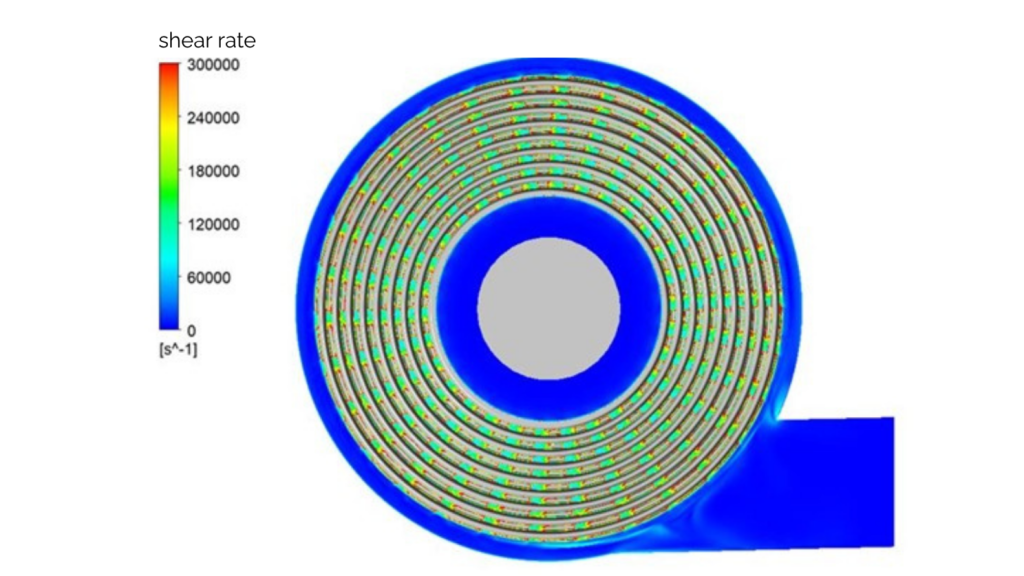
The critical difference: the rotor–stator architecture forces the product to pass sequentially through multiple high‑shear zones, multiplying droplet/particle break‑up events and improving the overall process efficiency.
Unlike conventional rotor–stator mixers, where action is essentially one‑shot as the product is propelled through a single ring of slots, this mixer forces the fluid to cross multiple active gaps before leaving the head. This effectively increases the number of break‑up opportunities per unit time, helping converge towards a narrow distribution without over‑processing the product.
In this way, it offers results comparable to colloid mills or high‑pressure homogenisers, with a more compact, hygienic and cost‑competitive solution in terms of investment and inline integration.
The result: Gaussian distribution centred at 5 µm, 90% < 8 µm
At the colloidal level, the quality of an emulsion is defined by droplet size and the narrowness of the distribution. Smaller droplet sizes increase interfacial area and, with the right surfactant, reduce the chance of coalescence or flocculation – stabilising the system against gravity and impact‑induced coalescence.
The MICELVAK’s multi‑tooth design promotes repeated, progressive fragmentation, keeping residence time under control and limiting or increasing flow rate as needed.
In measurable terms, the system can achieve a Gaussian distribution centred at 5 µm, with 90 % of particles under 8 µm, which translates into:
- Silky, consistent texture
- Stable appearance batch to batch
- Predictable & repeatable rheology
- Drastic reduction of coalescence and phase separation
Volume density (%)Size classes (μ
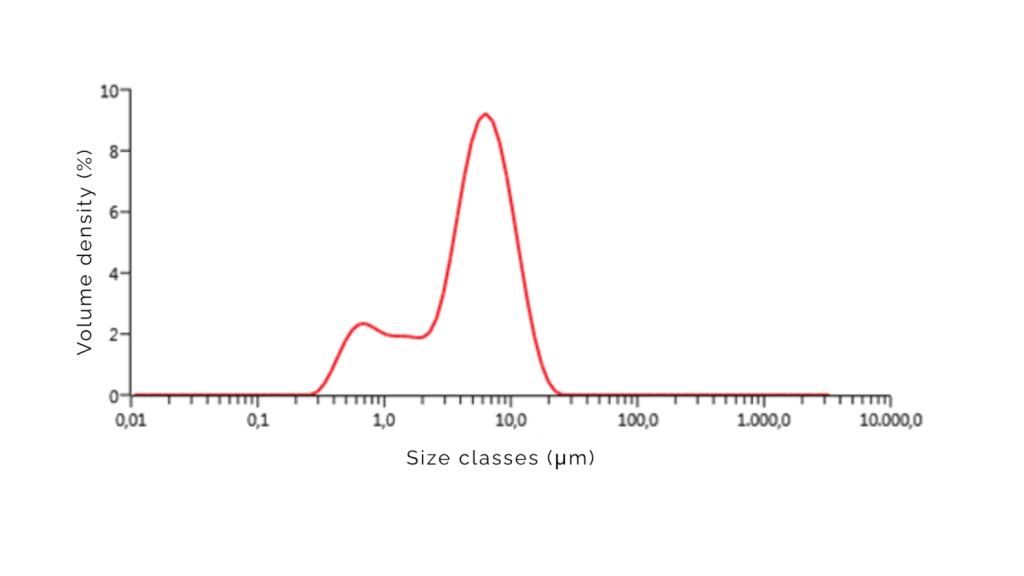
This distribution profile isn’t accidental: it’s the result of a specific design combining multiple concentric rows of teeth, tight rotor–stator gap tolerances and peripheral speeds up to 50 m/s, which provide high shear rates and steep velocity gradients at droplet/particle edges.
And not only for emulsions: the same repeated shear technology works for solid suspensions too, where it helps overcome agglomeration forces and achieve the same distribution profile (5 µm / 90 % < 8 µm), improving optical homogeneity, sedimentation stability and rheology in applications such as coatings, inks, pharmaceutical suspensions and formulations where tactile sensation or visual aspect are key.
Real operational control: Three levers to optimise the process From an operational perspective, MICELVAK facilitates fine process control with three main levers:
- Rotor speed Adjustable via a variable‑frequency drive (VFD) to tailor the specific energy applied. This allows modulation of shear intensity according to the process phase and sensitivity of raw materials.
- Rotor‑stator gap distance Adjustable by shims to modulate the gradient intensity. A tighter gap intensifies shear; a wider gap facilitates passage of more viscous products or those with high solids load.
- Medium viscosity Conditioned by formulation and temperature, influences energy transfer and the break‑up/co‑alescence dynamics. Thermal control and management of the continuous phase are key to stabilising the emulsion.
The combined optimisation of these three factors reduces the number of passes or recirculations needed, enabling a balance between energy efficiency and final stability. This translates into:
- Less processing time
- Lower energy consumption
- Less heating
- Greater batch-to-batch repeatability
Inline integration and predictable scale‑up
From a process engineering perspective, the MICELVAK mixer simplifies inline integration and scale‑up. The compact head geometry and its multi‑stage philosophy translate into predictable responses when increasing flow rate or rotor diameter, and allow mixed recirculation‑bypass strategies to adjust residence time without compromising temperature.
The equipment is CIP/SIP compatible when configured accordingly, reducing downtime and microbiological cross‑contamination risk – a critical point in food and pharma.
This means what you develop in R&D with a lab‑scale MICELVAK can be scaled into production with confidence, maintaining the same quality specifications and without operational surprises.
CONCLUSION: Control, Consistency and Competitiveness
In summary, MICELVAK delivers micrometric control, industrial consistency and economic efficiency in emulsification and dispersion processes where every micrometre counts.
The combination of a multi‑tooth head, tight tolerances and finely tuneable process parameters makes this equipment a versatile platform for R&D and production, capable of elevating the final product quality and accelerating market launch with demonstrable repeatability.

Because in critical processes, every micrometre counts. And the difference between a good product and an excellent product is measured exactly here: in the control you have over it.