Achieving consistent emulsification is not simply a matter of spinning faster.
Many formulators chase rotational speed or tip velocity, only to find that droplet size distribution remains unpredictable and unstable. The real variable is shear exposure — how much of the product experiences effective shear, how often, and under what flow conditions.
At Vak Kimsa, we engineered the Micelvak inline emulsifier around this principle: geometry drives performance, not speed alone.
Shear is a field, not a number
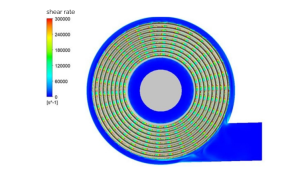
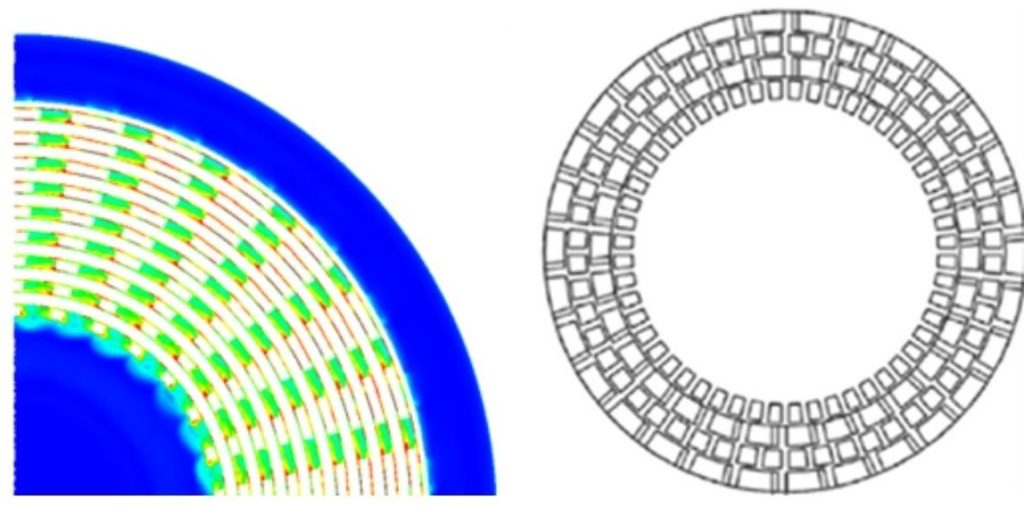
When discussing emulsification, the industry tends to reduce shear to a single figure. CFD analysis tells a different story. Shear rate is not uniform across the rotor domain — it concentrates in discrete zones defined by tooth height, channel number and channel width. A rotor producing extreme local shear in a small volume can underperform against one that delivers slightly lower, but far more evenly distributed, shear across the full flow.
This is the core design challenge for any inline emulsifier: maximising the fraction of the product that experiences shear sufficient to overcome interfacial restoring forces, on every pass.
The Micelvak CFD study
To answer this challenge with data, we ran a structured CFD study evaluating 27 rotor tooth configurations. Three geometric parameters were varied:
- Tooth height
- Number of channels
- Channel width
All simulations were run under identical operating conditions to ensure direct comparability:
- Rotor speed: 4,500 rpm
- Peripheral speed: 50 m/s
- Flow rate: 10 m³/h
- Fluid: water
Shear rate was selected as the primary performance metric for its direct relevance to droplet deformation and emulsification efficiency. Inlet pressure was monitored in parallel to assess mechanical feasibility.
Tooth height: the dominant variable
The CFD shear rate maps make one trend immediately clear: lower tooth height generates higher shear rates across a significantly larger proportion of the rotor domain.
Configurations with 6 mm tooth height consistently showed a larger high-shear volume — more of the flow operating in the red and orange regions of the shear map — compared to 10 mm and 15 mm designs. This is not a marginal difference. It fundamentally changes the emulsifying conditions the product experiences on each pass through the rotor.
The mechanism is straightforward. Shorter teeth compress the distance over which velocity gradients develop, intensifying shear while preserving flow continuity.
Channel geometry: a statistical effect
Unlike tooth height, the effect of channel number and channel width is not immediately visible in shear rate colour maps. Many configurations look similar at a glance. To resolve this, we moved beyond visualisation and analysed shear rate distributions using histograms, focusing on the 6 mm tooth height group.
Shear rate values between 20,000 s⁻¹ and 200,000 s⁻¹ were binned, and the volume fraction of the rotor domain exposed to each shear range was calculated.
The result is clear: configurations with higher channel number and wider channels expose a greater volume fraction of the flow to shear rates above 100,000 s⁻¹. Among the eight 6 mm configurations analysed, HSM6, HSM7 and HSM8 stood out as the most effective in populating the high-shear regime.
Increasing channel number and width does not raise peak shear — it raises the probability that any given fluid element experiences high shear during its residence time. This directly links geometry to shear exposure uniformity.
Weighted average shear rate: the objective metric
To identify the optimal configuration objectively, we calculated the weighted average shear rate for each design — combining shear intensity with the corresponding volume fraction of the domain exposed to it.
This avoids the trap of optimising for extreme peak values that affect only a small fraction of the flow.
The results point consistently to one configuration:
HSM6
- Tooth height: 6 mm
- Number of channels: 30
- Channel width: 8 mm
HSM6 delivers the highest weighted average shear rate among all viable designs, representing the best balance between shear intensity and shear coverage.
Pressure constraints and the practical operating window
High shear performance is only relevant if it can be delivered safely and reliably. Excessive inlet pressure translates directly into axial loads on bearings and the rotor assembly, reducing service life and introducing mechanical risk.
The CFD pressure analysis establishes a clear constraint:
- Maximum acceptable inlet pressure at 10 m³/h: 7.5 bar
HSM6 reaches approximately 7.6 bar at maximum flow — just above the conservative mechanical threshold. The recommendation is therefore to operate HSM6 at 8–9 m³/h, where inlet pressure remains safely within limits while maintaining superior shear performance.
Geometry optimisation must always consider the full process window, not just peak capability.
What HSM6 delivers for O/W emulsification
From a process perspective, the HSM6 geometry provides three concrete advantages:
Higher probability of droplet breakup — a larger fraction of the flow experiences shear sufficient to overcome interfacial tension on every pass.
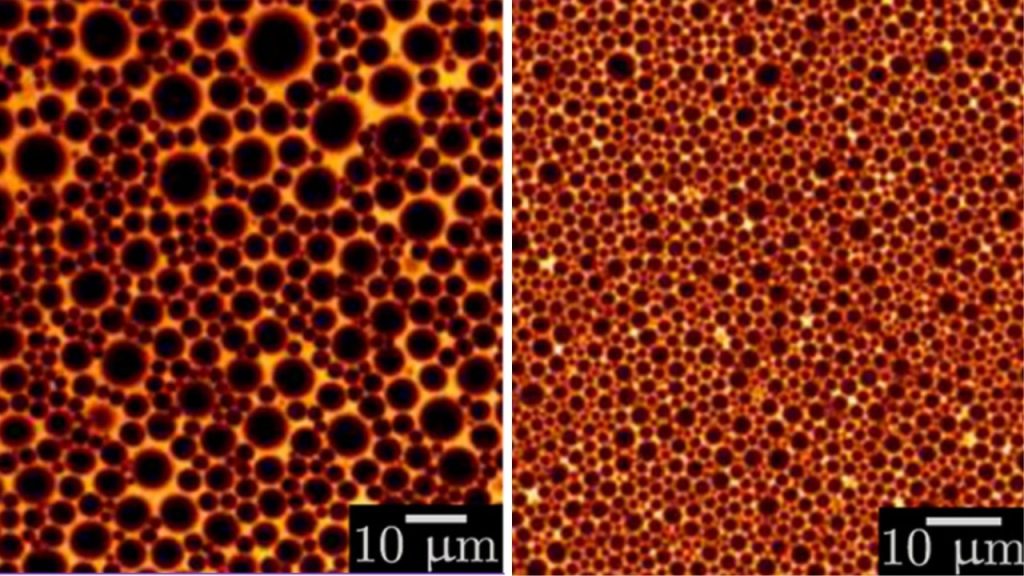
More uniform droplet size distributions — repeated, controlled shear exposure reduces the population of under-processed droplets and narrows the distribution.
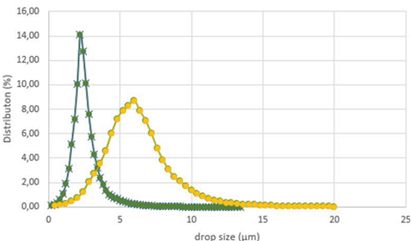
Lower dependence on extreme operating conditions — effective emulsification is achieved without pushing speed or pressure to mechanical limits, extending equipment life and reducing process variability.
Scale-up implications
Because HSM6 performance is geometry-driven rather than speed-driven, scale-up becomes more predictable. Maintaining flow rate and geometry ratios preserves the shear field without requiring blind increases in energy input. This is precisely why multi-stage inline systems based on this geometry can replace more energy-intensive technologies for a wide range of oil-in-water emulsions.
Conclusion
Emulsification performance is not defined by how fast a rotor spins. It is defined by how much of the product experiences the right shear, for long enough, within a mechanically safe operating window.
The Micelvak CFD study demonstrates this with data: tooth geometry controls shear distribution, residence time exposure and process feasibility.
HSM6 does not simply increase shear. It puts shear where it matters — across the largest possible fraction of the product, on every pass, within a safe and reliable process window.
High shear performance is only relevant if it can be delivered safely and reliably.
Have a mixing challenge you’d like to solve?
Our process engineering team is here to help — generating the best ideas and solutions for your mixing processes. Get in touch with us and let’s find the right answer together.