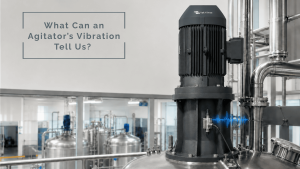
Vibration in an industrial agitator does not always indicate a mechanical fault, as process conditions, installation and operating parameters can significantly affect the machine’s behaviour. The real challenge is to distinguish normal vibration from an emerging deviation before it causes an unexpected shutdown.
From Symptom to Decision
All rotating equipment generates vibration. Therefore, the fact that an agitator vibrates does not necessarily mean that it is faulty.
The truly useful question is not whether it vibrates, but how it vibrates, under what operating conditions and how that vibration has evolved over time.
When interpreted correctly, vibration can become a valuable source of information. It helps us understand the mechanical condition of the equipment, detect changes at an early stage and plan an intervention before an anomaly results in an unexpected shutdown.
An Agitator Does Not Operate in Isolation
The vibrational behaviour of an agitator depends on the complete assembly formed by the motor, gearbox, bearings, shaft, impeller, support structure and vessel. However, it is also influenced by the product and the operating conditions.
Changes in speed, filling level, viscosity, density, solids content or air entrainment can modify the forces acting on the impeller. Even two batches produced in the same equipment may generate different vibration responses when their process conditions are not comparable.
This interaction between mechanics and process conditions is precisely why diagnosing mixing equipment requires context. An isolated reading may reveal a deviation, but it rarely explains its cause on its own.
Where Can Vibration Come From?
The causes of vibration can be grouped into three main categories:
➤ Mechanical causes: These include imbalance, misalignment, looseness, bearing wear, gearbox problems or shaft deformation. Irregular product build-up on the impeller can also alter the balance of the assembly.
➤ Structural causes: These are related to the rigidity of the support, fastening points, vessel geometry or proximity to a resonant frequency. In such cases, a relatively small excitation can be amplified through the structure.
➤ Process-related causes: These include vortex formation, irregular solids feeding, the presence of gas, significant changes in viscosity or operation outside the intended process conditions.
When vibration increases, immediately replacing a bearing or balancing a component without analysing the complete system may not solve the actual problem.
The Key: Comparing Equivalent Measurements
For vibration measurements to be comparable, they must be taken at defined points and in defined directions, using appropriate instruments and recording the operating conditions.
Agitator speed, filling level, product, temperature and batch stage are essential data for interpreting the results.
It is also important to distinguish between the overall vibration value, the analysis of its frequency components and its evolution over time. Trending can identify gradual changes that a single measurement might overlook, while the vibration spectrum can provide clues about specific phenomena:
▸ A dominant peak at 1× the rotational speed usually directs the analysis towards a possible imbalance.
▸ A high axial component at 1× or 2× may be consistent with misalignment.
▸ A sequence of harmonics may indicate mechanical looseness.
▸ Bearings generate characteristic frequencies according to their geometry.
▸ Gearboxes present a gear-mesh frequency related to the number of teeth and rotational speed.
Technical standards such as ISO 20816-3:2022 provide general assessment criteria for different types of industrial machinery. However, their values must be applied while considering the characteristics of the equipment, its installation and its operating regime.
For agitators, establishing a baseline under known operating conditions is particularly useful. This makes it possible to define the normal vibration signature of each machine and identify significant deviations.

From Data to Decision
The monitoring strategy should be adapted to the criticality of the equipment. It may begin with periodic inspections and measurement routes and progress towards continuous monitoring when an unexpected shutdown would have a major impact on production.
Combining vibration, temperature and process variables provides a more complete understanding of the equipment’s condition.
When these data are also stored, displayed as trends and supported by alarms and technical assessment, maintenance is no longer purely reactive. Interventions can then be scheduled using better information, reducing urgent repairs and avoiding unnecessary component replacements.
At VAK KIMSA, we combine vibration measurement, bearing diagnostics, thermographic inspections and mechanical checks. Our Predictive Maintenance 4.0 solution adds vibration and temperature sensors, connectivity, historical data, alarms and assessment by our technical service team.
The objective is not to achieve a machine that never vibrates. The objective is to understand how it behaves when operating correctly and to detect, at an early stage, when something begins to change.
Do You Know the Normal Vibration Signature of Your Agitators? Or do you only take action when an alarm appears?
VAK KIMSA’s Technical Assistance Service can establish a vibration baseline, carry out periodic measurements and diagnostics or implement continuous monitoring.
These services are available for both VAK KIMSA agitators and equipment manufactured by other suppliers. Contact our Technical Assistance Service and we will define the monitoring strategy best suited to your installation.