From powder to homogeneous product: solving solid-liquid mixing challenges in the food industry
How can food manufacturers improve powder incorporation, reduce lump formation, and achieve more uniform blends?
The answer starts with understanding the process and choosing the right technology.
In food manufacturing, achieving a homogeneous product goes beyond the formula — beyond simply adding an ingredient to a liquid and agitating it.
Powder ingredients such as starches, stabilisers, thickeners, sugars, and other functional ingredients can behave very differently when they come into contact with a liquid. Depending on their properties and process conditions, they can form lumps, disperse unevenly, or require considerable processing time to reach the desired consistency.
For sauce manufacturers, for example, these challenges can affect product quality, production efficiency, and batch-to-batch uniformity.
So how can the mixing process be improved?

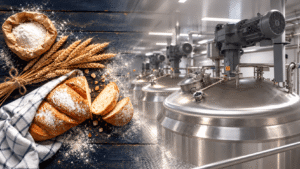
Flour inlet – sourdough agitation tank
The challenge: incorporating powder without unwanted agglomerates
When a powder comes into contact with a liquid, the outer surface is wetted first. If the liquid does not penetrate uniformly between the particles, the outer layer can hydrate or thicken before the interior has been properly wetted.
This can lead to agglomerate formation: lumps with a hydrated outer layer that may contain dry powder inside.
The result can be a blend that appears homogeneous at first glance, but still contains poorly dispersed particles. In some cases, the manufacturer must extend mixing time to achieve the required consistency.
This behaviour depends on several factors:
- Ingredient properties: particle size, wettability, solubility, and hydration behaviour
- Liquid characteristics: viscosity, temperature, and composition
- Addition procedure: powder incorporation rate and entry point into the process
- Mixing conditions: circulation pattern, energy input, and equipment effectiveness
Increasing the speed of a conventional agitator is not necessarily the best solution. The key is ensuring that ingredients are incorporated under the right conditions for each formulation.
Not all applications require the same equipment. Product volume, formulation characteristics, and the difficulty of incorporating the ingredients are determining factors in selecting the most appropriate solution.
As examples:
- MULFO-LK: an impeller that, as an agitation solution, is applicable for small volumes
- ALVAK and VISCOVAK: inline mixing solutions to consider for high-volume processes or when working with particularly difficult-to-mix products
The system adapts to the formulation, the production method, and the characteristics of the ingredients to be processed — not the other way around.
At Vak Kimsa we offer agitation and mixing solutions for every process. In today’s article we focus on inline mixing.
Dynamic inline mixing adapted to each application
A dynamic inline mixer offers an alternative to conventional mixing carried out exclusively inside a tank.
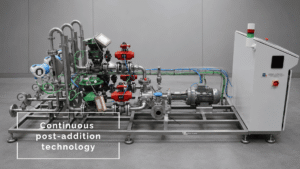
In this type of equipment, the product circulates through a dedicated mixing chamber, where it undergoes repeated changes in flow direction that promote mixing and contribute to a more uniform product.
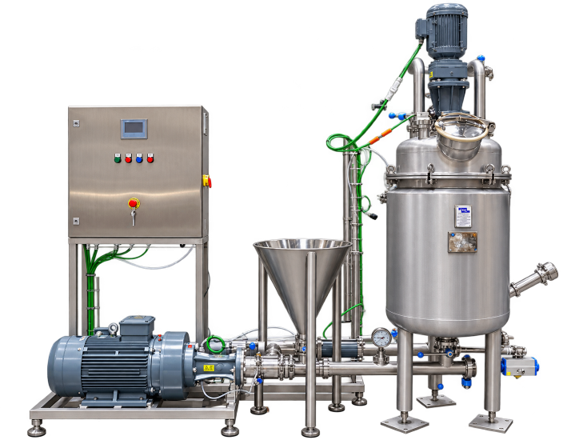
In solid-liquid applications, one possible configuration involves incorporating the powder ingredients into the liquid inside the manufacturing tank, while the product is continuously recirculated through the inline mixer.
This arrangement allows the mixing action to be concentrated in a specific zone of the process, rather than relying solely on the circulation generated by the tank agitator.
Which inline mixer is most suitable?
Production volume, product characteristics, and the difficulty of incorporating the ingredients are key factors in selecting the most appropriate technology and equipment.
The final selection depends on the characteristics of each application and the process objectives.
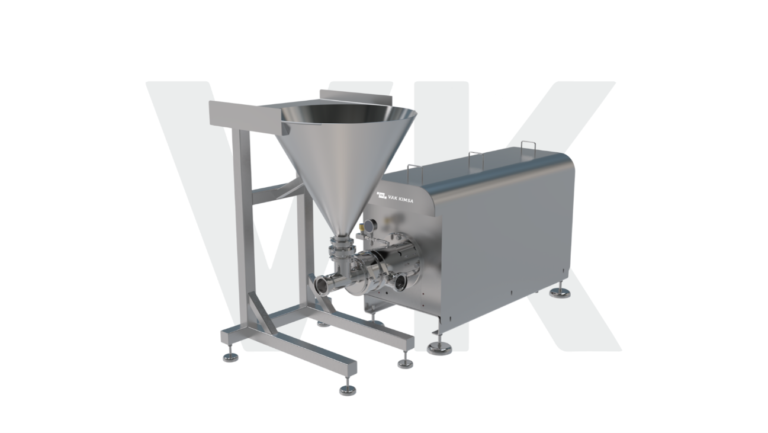
ALVAK and VISCOVAK are in-line mixing units designed for high volumes or particularly demanding applications.
When production volume increases or the formulation presents particular mixing difficulties, solutions that respond to the specific demands of the process must be considered.
In these cases, our inline mixers allow tailored solutions to be developed for higher-volume industrial applications or for products that require special attention during ingredient incorporation and mixing.
The selection between different technologies depends on factors such as viscosity, solids concentration, ingredient behaviour, working flow rate, and the desired outcome.
The objective is not simply to achieve a blend, but to define a process suited to the actual manufacturing requirements.
How does the process work?
In a solid-liquid mixing application, the process can be organised into three main stages. The specific configuration will depend on the mixer selected and the characteristics of each application.
1. Preparation of the liquid phase
Liquid ingredients are introduced into the manufacturing tank under the required process conditions. Depending on the formulation, it may be necessary to control the initial temperature and viscosity.
2. Addition of powder ingredients
The powder is incorporated progressively while the product circulates through the inline mixer. The rate of addition and the incorporation point are important factors in avoiding excessive local powder concentrations.
3. Continued mixing until the required characteristics are achieved
The product continues to recirculate through the system for the time required by the formulation. The end point of the process must be established according to the homogeneity, texture, and other product specifications.
The process must be validated for each application, as different ingredients can behave very differently even under apparently similar operating conditions.
What benefits can inline mixing bring to the food industry?
When correctly selected and integrated into the process, a dynamic inline mixer can help manufacturers address several common challenges.
- Improved powder dispersion
The mixing action promotes ingredient distribution in the liquid phase and can help reduce local concentrations and uneven incorporation. - Greater process uniformity
A controlled mixing configuration can contribute to more repeatable results, provided that the formulation, ingredient addition, and operating conditions are also controlled. - Processing time optimisation
Depending on the product and existing installation, inline mixing can help optimise the time required to achieve the desired characteristics. Real improvement must be assessed through application-specific trials. - Greater flexibility in process design
An inline mixer can be integrated into a recirculation circuit or adapted to other suitable process configurations, depending on production requirements.
It is worth remembering that dissolving and dispersing are not the same thing. For an ingredient to dissolve, it must have adequate solubility and sufficient time under favourable conditions. Similarly, some ingredients need to hydrate, swell, or disperse into smaller granules in the liquid phase.
The equipment must therefore be selected according to the actual process objective: dispersion, dissolution, hydration, homogenisation, or a combination of these operations.
One technology for different food applications
Solid-liquid mixing challenges arise in a wide variety of food manufacturing processes, including:
- Sauces and dressings containing thickeners or stabilisers
- Creams and food bases prepared with powder ingredients
- Syrups and liquid preparations requiring the incorporation of soluble solids
- Formulations with starches, sugars, or other functional ingredients
Each application requires a specific assessment. The most appropriate solution depends on the formulation, the desired final characteristics, and the production conditions.
The right mixing solution starts with the process
The success of a mixing process does not depend solely on the equipment. It also requires understanding how the ingredients behave, how they are incorporated, and what characteristics the final product must have.
At Vak Kimsa we work with industrial mixing technologies designed to address real manufacturing challenges. From small volumes to solutions for high volumes or particularly difficult-to-mix products, we assess the needs of each process to identify the most appropriate technology.
Are you experiencing difficulties incorporating powder ingredients into your liquid products?
Contact our team to assess your application and find the most suitable mixing solution for your process.
Get in touch!