Lithium has become a strategic material for the automotive industry as the core component of the batteries that power most electric vehicles. Achieving the “battery grade” purity this market demands depends largely on the agitation process: an efficient, safe design ensures homogeneity within the tank, prevents the formation of unwanted by-products, and guarantees process performance. It is precisely this dual guarantee — of product and of process — that must guide the design of any agitation system in this sector.
Lithium has become one of the most strategic materials in the automotive industry. It is the core component of the lithium-ion batteries that power the vast majority of today’s electric vehicles (EVs), thanks to their high energy density, long service life, and low weight compared with other battery technologies.
This central role explains why, as global EV demand grows within the shift toward more sustainable mobility, the need for lithium — and for a reliable, efficient supply — has kept rising.
Behind this supply chain lies an engineering challenge that often goes unnoticed: getting lithium to “battery grade” quality involves chemical and physical processes with a high level of control, where product purity, reaction conditions, and process homogeneity are key factors. In many of these processes, agitation plays a decisive role.
Why agitation is critical in lithium processing
Throughout the entire process of obtaining battery-grade lithium — from brine concentration or ore treatment through to the final precipitation of lithium carbonate or hydroxide — industrial agitators play a key role in ensuring proper product homogeneity, as well as efficient heat and mass transfer. These factors are decisive for controlling process conditions and can directly influence reaction rate, crystal formation, and the final quality of the product.
When agitation is inadequate, poorly mixed zones appear within the tank: concentration, temperature, or pH gradients that favor the formation of unwanted by-products. These by-products reduce the purity of the final lithium and, as a result, the capacity and performance of the battery produced from it. Well-designed agitation, by contrast, reduces product rejection and increases the plant’s overall yield.
The technical challenge: homogeneity, flow regime, and mixing time
In lithium processing, homogeneity requirements within the tank can be very demanding, especially at stages where concentration, temperature, or precipitation conditions must be controlled. In these cases, the agitation system must generate a flow regime capable of achieving the required degree of homogeneity in the shortest possible time. The mixing time needed will depend on factors such as tank geometry, product properties, agitator design, and operating conditions.
This complexity increases further because, at various stages of lithium processing, suspensions with demanding hydrodynamic behavior are involved, where the flow regime can fall between transitional and turbulent conditions depending on solids concentration, viscosity, and operating conditions. This behavior is shaped by factors common to these processes, such as the presence of suspended solids and fine particles.
Under these conditions, mixing time depends heavily on the design of the chosen agitation system: the type of impeller, its geometry, diameter, rotational speed, and its position within the tank.
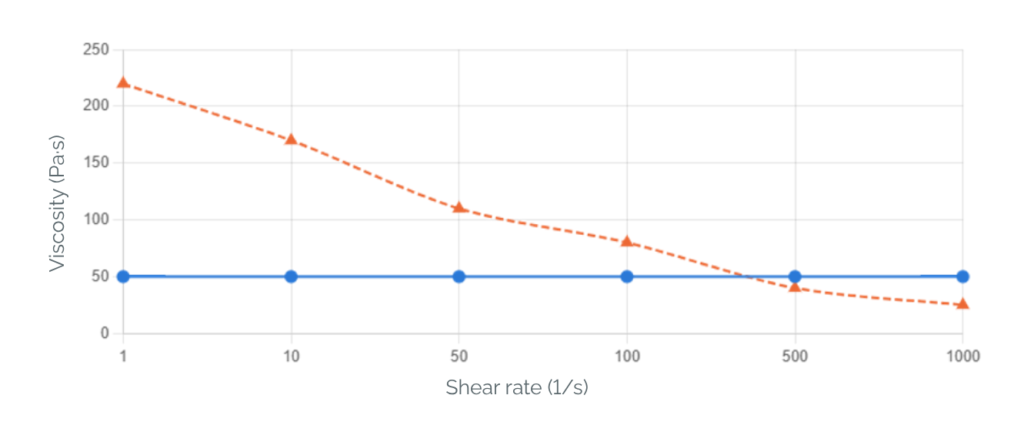
The practical consequence is clear: choosing an unsuitable system or blade can extend mixing time to the point of compromising the industrial viability of the process. Added to this is another factor present at certain stages of lithium processing: the complex rheological behavior of some concentrated suspensions, which calls for a specific agitation design rather than a generic approach.
How Vak Kimsa would approach it
At Vak Kimsa, we have spent decades designing custom agitation systems for processes with demanding homogeneity requirements and complex-behavior fluids.
If you’d like to learn about our solution for your lithium processing or any other product, just get in touch with us.
For every project we use our proprietary calculation tools, SMARTVAK and VAKCAL, which let us size the mixing behavior before manufacturing — avoiding the extra cost, in time and product, of a poorly calculated system.
Beyond the equipment: service and tailored engineering
In a sector where every lithium processing plant has its own process conditions, the agitation equipment is only part of the equation. At Vak Kimsa, we offer complementary services for every installation, including:
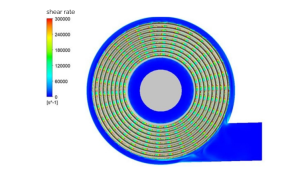
• Custom engineering through CFD simulation, to validate the design before start-up.
• Pilot plant, when the process requires it, we complete validation at our pilot plant, where we can reproduce real mixing conditions — including non-Newtonian fluids — before putting the system into operation at industrial scale.
• Local technical support service (TSS), guidance during installation and start-up.
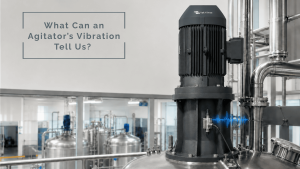
• 4.0 predictive maintenance, with IoT monitoring (agitators) that allows unplanned shutdowns to be anticipated. (see our previous post)
In a market where the reliability of lithium supply directly determines the pace of electric vehicle growth, well-designed agitation becomes a strategic factor across the entire value chain.