The real issue: An operation that seems to work, but conceals critical inefficiencies.
The industrial mixing operation in chemical, food, pharmaceutical or cosmetic industries demands a fine balance between power, residence times that guarantee quality without slowing productivity, and similarity criteria that ensure scalability (from lab to plant) without penalising productivity or quality.
The hidden challenge: In many agitated tanks, the actual hydrodynamic efficiency is masked by an operation “that works,” yet is not optimised.ReproducirIt works, but… is it efficient?
In viscous mixtures it is common to observe intense agitation but localised near the impellers, while the axial velocity throughout the tank is very limited.
The result: little exchange between levels and risk of dead zones between stages.
The solution: correctly selecting the impeller geometry and the ratio between the impeller diameter and the tank diameter.
Typical symptoms include:
- Dead zones and weak recirculations that increase the characteristic mixing time.
- Inter-batch variability despite constant recipes and set points.
- Elevated energy consumption for the achieved degree of mixing.
- Excess shear that degrades polymers, emulsions, biomass, or induces crystal breakage.
- Risks in scaling from pilot to plant due to changes in flow regime or geometric variations.
The exclusive reliance on empirical methods and the lack of visibility inside the tank turn every improvement into a costly trial and error: production interruptions, raw material consumption and iterations that last weeks. The usual response: “more rpm” or “longer process time,” which raises OPEX without addressing the root cause.
How and where are velocity, energy dissipation and shear distributed within the usable volume?
E͟f͟f͟i͟c͟i͟e͟n͟c͟y͟ ͟E͟v͟a͟l͟u͟a͟t͟i͟o͟n
The Efficiency Evaluation is a technical assessment based on CFD (Ansys) integrated at Vak Kimsa, which focuses on evaluating the performance of the agitated reactor through the characterisation of the system’s hydrodynamics.
The results are oriented to achieving the key benefits and outcomes of:
- Energy efficiency improvement
- Process optimisation
- Reliable scaling
B͟e͟n͟e͟f͟i͟t͟s
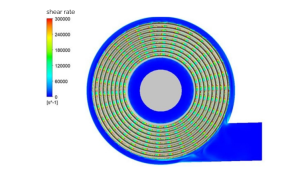
Computational Fluid Dynamics (CFD) is an essential tool in our analysis and optimisation of industrial agitated reactors. This tool allows us to gain a detailed understanding of the hydrodynamic behaviour inside the tank, including velocity distribution, shear gradients, flow patterns and recirculation zones.
1. System agitation design optimisation
The simulation allows comparison of different impeller types, deflector configurations, mounting heights and rotation speeds, identifying those combinations that:
- Maximise mixing homogeneity
- Minimise energy consumption
- Reduce batch times
- Improve the efficiency of heating or cooling processes
We aim to maintain the optimal compromise between agitation efficiency and operating cost, contributing to sustainability and process efficiency.
2. Reliable process scaling
CFD facilitates the evaluation of scalability of results from laboratory or pilot plant to larger capacity equipment, by allowing analysis of phenomena that are not linearly proportional with scale, such as shear stress distribution or mass and heat transfer.
It is fundamental for improving process performance and selectivity.
3. Tailoring the solution to each process
Each industry has its particularities.
- Cosmetics: shear sensitive mixes and emulsions.
- Food: emulsions and suspended solids.
- Chemical: dissolution of reactants and thermal control.
- Pharmaceutical: CIP (clean in place) processes and homogeneity validation.
With our technical expertise we can adapt the agitator design to the specific needs of our partners, the industrial producers.
4. Reduction of costs and development time
CFD studies help reduce costs and development time and the need for physical prototypes. They allow us to virtually validate different design alternatives prior to manufacturing.
How It Works – Workflow
The workflow that Vak Kimsa follows is clear, efficient and easily replicable:
1. Initial consultation and process briefing
In this phase we collect detailed information about the required process. From this data we define the evaluation criteria and key parameters for the simulation, ensuring that the CFD model faithfully represents the real operating conditions.
2. CFD simulations
A three-dimensional model of the reactor is developed, and our experts carry out the calculation via the Ansys simulation software.
3. Analysis and recommendations
Based on the simulation results, we analyse the system efficiency parameters. These data allow us to identify opportunities for improvement in the impeller geometry, number of deflectors or operating conditions. Finally, we prepare a technical recommendation report that guides process optimisation towards higher efficiency and homogeneity.
4. Implementation and plant transfer
The conclusions of the analysis are transferred to the design phase, subsequent agitator construction and transfer to the production plant.
In some cases, we may recommend a pilot scale experimental validation before construction.
Both approaches ensure the proposed solution is technically viable and aligned with performance objectives.
Results We Seek
At Vak Kimsa we aim for verifiable impacts at plant scale, highlighting:
- Energy efficiency: the power that truly helps mixing, not generating useless vortices.
- Consistent quality: lower variability between batches and fewer adjustments.
- Reliable scaling: clear rules to move from pilot to production.
- Reduced development time and cost: fewer prototypes and better informed decisions.
Case study
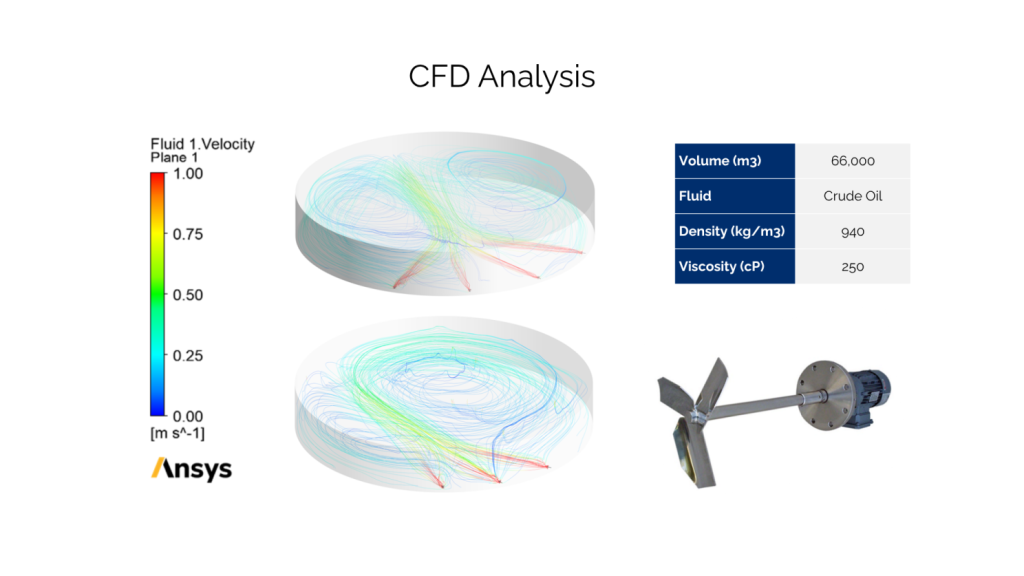
In a large capacity tank (66,000 m³) intended for crude oil storage, the client’s original design contemplated the installation of 4 side-mounted agitators.
Based on the CFD analysis performed by Vak Kimsa, multiple configurations were evaluated optimising both geometry and relative position of the agitators.
Result: the number of units was reduced from 4 to 3 agitators per tank; whilst maintaining, and even improving, circulation velocity and active volume coverage.
This improvement would not have been visible without detailed CFD simulation.
Benefits achieved
- Lower equipment and maintenance investment.
- Higher energy efficiency per agitated tank.
- Better process performance with less mechanical complexity.
Why Vak Kimsa
Beyond the software, what really sets us apart is combining CFD with real agitation experience. We design and manufacture agitators and complete installations; we understand tolerances, maintenance, CIP and safety. Every recommendation arises from physics (CFD) and from our experience.
Advantages:
- A single team for simulation, mechanical design and commissioning.
- Clear communication: reports you can read and actionable decisions.
- Confidentiality and focus on process value, not the “mysticism” of simulation.
If you recognise yourself in any of the challenges described, let’s talk! How will we proceed? We will start with a quick review of your current equipment and send you a proposal for a bounded CFD study aligned with your objectives.
Then you decide if we advance towards optimisation and/or scaling.
What’s on your mind? We’re all ears for your suggestions.
Our monthly news “Mixing With You!” is as much yours as it i sour -let’s hear what you would like to read about. Send us an email to our marketing team (marketing@vakkimsa.com), relevant topics and your ideas matter to us! Thank you.